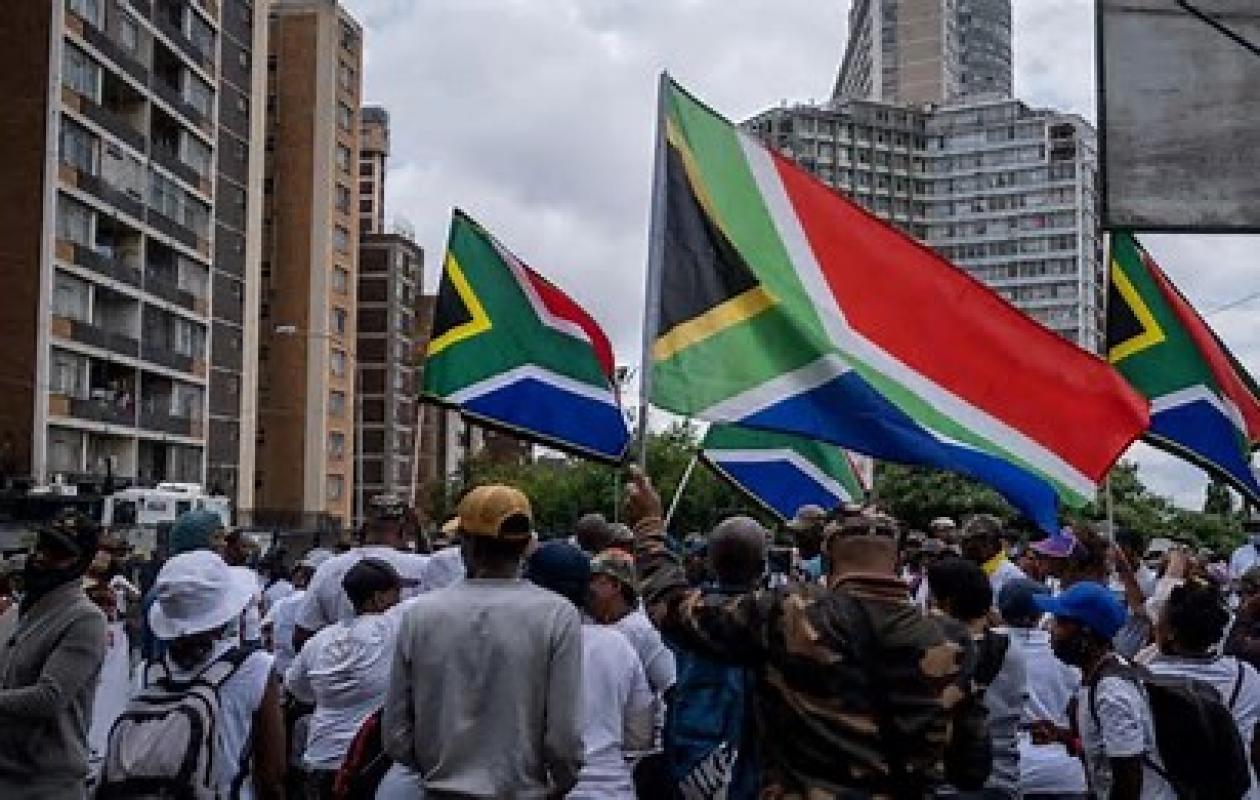
Hausse de la xénophobie en Afrique du Sud : qui orchestre les manifestations anti-migrants ?
On Tuesday, June 30, thousands of South Africans took to the streets of the country's major cities (Johannesburg, Pretoria, Durban) to protest against illegal immigration. While South Africa has been plagued by waves of xenophobic violence for over two decades—the deadliest incident having claimed around sixty lives in 2008—the current mobilization is distinguished by an unprecedented level of organization and structure. Anti-migrant groups have even issued an ultimatum demanding the immediate departure of undocumented immigrants.
Behind these nationwide mobilizations are several civil society structures, now transformed into political actors:
Officially, these organizations focus their criticism on illegal immigration. Out of a population of 60 million, South Africa has approximately 3 million foreigners, mainly from neighboring countries (Zimbabwe, Mozambique, Malawi).
However, according to Cécile Perrot, a researcher at the University of Rennes II, the actual figures are subject to fantasies and wildly inflated estimates ranging from 4 to 15 million individuals. Accusations that migrants "steal" local jobs or monopolize social welfare are unfounded. In reality, these populations primarily hold precarious jobs in the informal sector (small businesses, personal services). Moreover, on the ground, activists attack foreigners indiscriminately, without regard to their legal status.
Far from being mere spontaneous gatherings of impoverished citizens, these movements possess considerable financial resources, enabling them to fund buses, propaganda t-shirts, television campaigns, and press conferences. While they advertise online fundraising campaigns, experts point to far more institutional sources of funding.
Loren Landau, a researcher at Wits University, asserts that these organizations benefit from concealed external financial support. Several major political parties have publicly expressed their support for these demonstrations.
Waves of xenophobic violence in South Africa have rarely been accidental. While they were once orchestrated by local leaders to consolidate their influence in neighborhoods, this phenomenon has now spread to a national scale.
For experts, the timing of this sudden surge in anti-immigrant sentiment is no coincidence. With the municipal elections approaching in November 2026 , these organizations are exploiting fear of foreigners to position themselves on the political scene. As researcher Liesl Low Vaudran points out, the issue of migration remains an extremely effective tool for electoral mobilization in South Africa. Without offering any real, substantive solutions, these movements demonstrate their popular strength in the streets in order to pressure the government and negotiate political power.
















Commentaires (0)
Participer à la Discussion
Règles de la communauté :
💡 Astuce : Utilisez des emojis depuis votre téléphone ou le module emoji ci-dessous. Cliquez sur GIF pour ajouter un GIF animé. Collez un lien X/Twitter, TikTok ou Instagram pour l'afficher automatiquement.