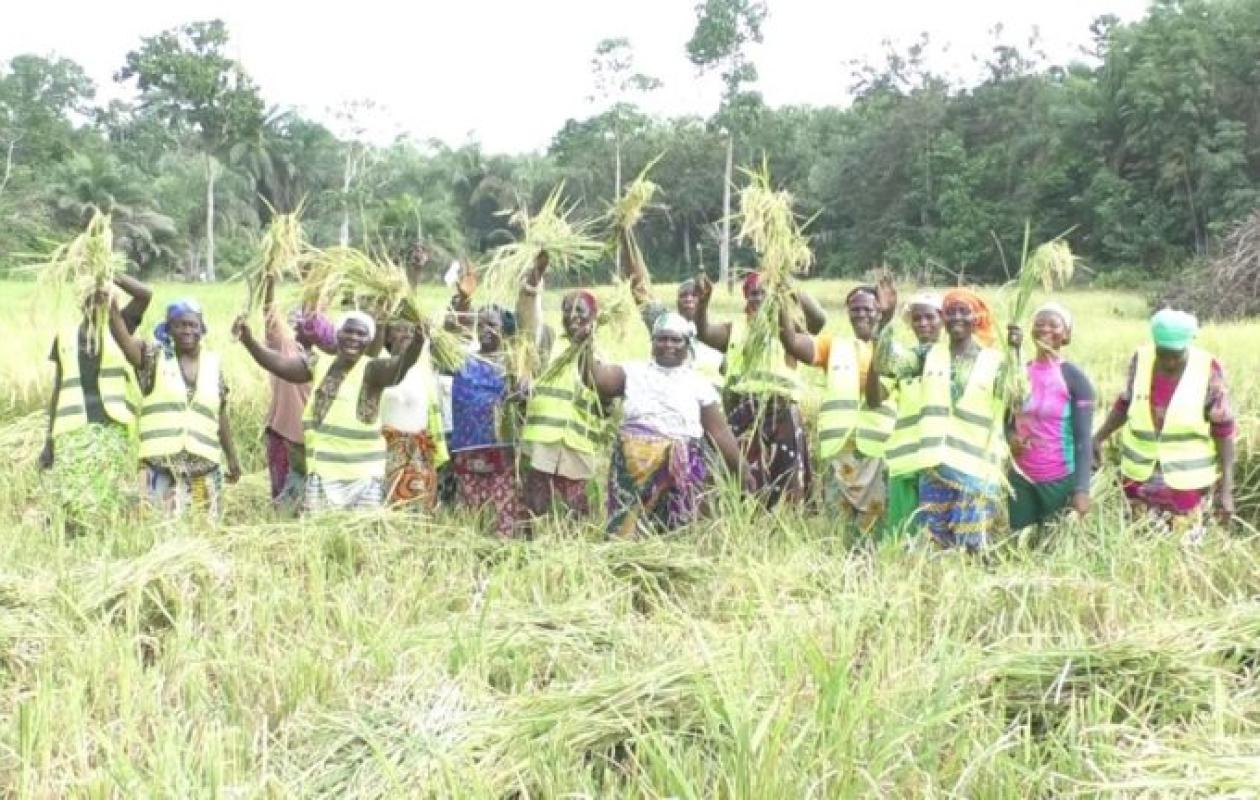
Dans le Cavally, le riz ouvre aux femmes le chemin de l’autonomie économique
Day is just breaking over the humid plains of Guiglo, in the Cavally region. In the cool morning air, groups of women advance single file through the rice paddies. Armed with sickles, they methodically cut the golden ears of rice to the rhythm of traditional songs. For these women farmers, rice has transcended the simple status of a subsistence crop: it has become a powerful tool for financial empowerment and a driver of social transformation.
Under an increasingly intense sun, the women are busy harvesting, gathering, and drying the sheaves. At the heart of this activity is the CHIGATA association, a group of Senufo women living in the region. Initially conceived as a mutual aid network, the organization has transformed into a genuine tool for economic development.
“Every harvest is a victory,” says Koné Katchia, president of CHIGATA. “Today, when we see the bags of rice piling up, we know we can feed our families and meet many expenses.”
The income generated from the sale of rice profoundly changes the daily lives of households:
This transition from subsistence farming to a structured sector relies on significant institutional support. The Cavally Regional Council is currently implementing the ECOTER project (Project to Support the Economic and Ecological Development of Rural Areas). This program is funded by the French Development Agency (AFD) through the Debt Reduction and Development Contract (C2D).
Dr. Ouattara Djamantigui, Director of Development at the regional council, emphasizes the area's potential: fertile soils, vast lowlands, and a favorable climate. The objective is clear: to make Cavally a competitive rice-producing region to eradicate poverty.
The impact on the ground is tangible, as evidenced by the Guiglo departmental rice farmers' cooperative in Yaoundé. Thanks to a grant of 5 million FCFA received in 2022, the cooperative was able to:
With an average annual production of 78,022.5 tonnes of paddy rice (according to ADERIZ), the Cavally region plays a significant role in the regional agricultural economy. However, there is still considerable room for growth.
While Côte d'Ivoire still relies heavily on imports to meet its domestic rice demand, the Cavally region has the potential to reduce this dependence. To fully unlock this potential, stakeholders in the sector have identified several key levers:
Despite these logistical and financial challenges, optimism prevails in the rice paddies of Guiglo. As night falls, the singing resumes. For these women, the success of a season is not measured solely in tons of rice, but in future prospects: children in school, preserved health, and hard-won freedom. By feeding Côte d'Ivoire, the women of Cavally are cultivating their own future.










Commentaires (0)
Participer à la Discussion
Règles de la communauté
💡 Astuce : Utilisez des emojis depuis votre téléphone ou le module emoji ci-dessous. Cliquez sur GIF pour ajouter un GIF animé. Collez un lien X/Twitter, TikTok ou Instagram pour l'afficher automatiquement.
Se connecter
Commentez avec votre profil, votre photo, et soyez averti des réponses.